


Sing, then you're winning - Social Identity Theory and Football Chants

With the football world cup in full swing, here's some 'football-adjacent' Psychology!
Psychologists have long known that a sense of belonging is an important part of human happiness (check out The How of Happiness by leading psychologist Sonja Lyubomirsky if you want to know more), but what is a sense of belonging and how can we get it? The answer might be surprising, with links to both Social Identity Theory and the Evolutionary perspective.
A Brief History of Belonging
In simple terms, a sense of belonging is a belief that we have meaningful, positive connections with others. The precise nature of this is likely to vary from one person to the next - some of us may crave connections to lots of people whilst others might prefer deeper, more personal connections to a select few. Either way, it is clear that we feel better when we feel together. This is likely to have deep evolutionary roots; early humans were very vulnerable in isolation and probably depended on our ability to work together in large groups to stay safe and find food. A human alone was a human at risk, so it is not surprising that knowing we have other people we can turn to makes us feel good. So far, so good, but how can we increase our sense of belonging if we feel like we need a boost?
Sing Up for Social Identity Theory
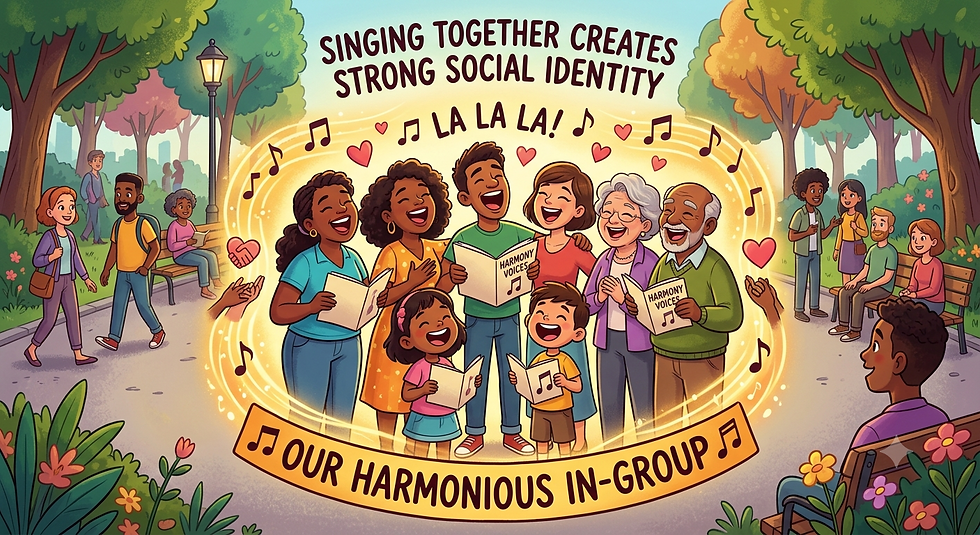
Haddad and Templeton (2026) interviewed some supporters of Celtic Football Club and found that singing as part of a group might be one way to develop our sense of belonging. Using thematic analysis to summarise their data, Haddad and Templeton found that football chants increase a sense of shared history, shared values and shared purpose leading to positive feelings of excitement, togetherness, connecting and belonging. If we think about it, there are lots of clues to help us understand why singing football chants as part of a crowd might have such a big impact on how we feel. Nobody has the lyrics, but everybody knows the words. There is no requirement to sing - people choose to do so (loudly and with passion!). The lyrics often include dialectal words or refer to people and events which have special significance for that particular city (or team, if the city has more than one). Throw in the fact that you fellow singers may also be wearing the same clothes as you (or at least merch from the same club shop!) and it is easy to see how this experience acts to clearly define a powerful in-group - a football fan in a noisy stadium is surrounded by people who know the same things, value the same things and have the same goals. In terms of Social Identity theory, these qualities of football chants make categorisation obvious, so it will be easy to identify strongly with this in-group when your team is successful.
On the downside ...
So singing together is good, especially if the songs contain the magic ingredients found in many football chants, right? Well, probably, but Haddad and Templeton also found that antagonistic identity content is also in play. Some football chants define the in-group (our team) by sharing negative opinions about one or more out-groups (the other team or, sometimes, all other teams). Football fans might recognise this in chants directed at local rivals, some of which are negative to the point of being offensive and even cruel. This could also be explained in terms of social identity theory - out-group homogeneity (believing that opposition supporters are all the same) combined with downward social comparison (believing that our in-group is better than an out-group) can help to increase our self esteem (because we feel superior to the out-group) but can also lead to conflict, especially if we feel the status of our in-group is in decline (because the team keeps losing). By this logic, the greatest risk of nasty chants and even aggressive behaviour might come from fans whose team seems to be getting worse (rather than fans of teams who are always useless!).
Think about this ...
This be a good topic for an IA.
How could you design a true experiment to investigate the effect of singing as part of a group?
Which sources of bias would you need to control?
How could you be sure that singing as part of a group causes any change in mood, self-esteem or thinking?
How could you measure these variables? what would an effective data collection tool look like?
HL Extension - Singing together is an important part of many cultures, but what function does it serve? Is it the same everywhere?
Further Reading
Haddad, R., & Templeton, A. (2026). The sound of Unity: Exploring shared social identity and identity expression through collective sound-making at live sports events. British Journal of Social Psychology, 65, e70095. https://doi.org/10.1111/bjso.70095
Lyubomirsky, S. (2007). The how of happiness: A scientific approach to getting the life you want. Penguin Press.


Comments